
Introduction
You’re walking your dog down the street when suddenly—bark, bark, BARK!—a jogger appears two blocks away, and your pup is already lunging, growling, and sounding like Cujo. Or maybe the doorbell rings, and your otherwise sweet dog transforms into a frenzy of barking that leaves guests waiting awkwardly on the porch. If this sounds familiar, you’re not alone. Barking at strangers is one of the most common—and frustrating—behavior issues dog owners face.
But here’s the good news: this behavior isn’t “bad manners” or “stubbornness.” It’s usually fear, anxiety, over-excitement, or a deeply ingrained instinct to alert or protect. And with the right approach, it can be managed—and often resolved—without punishment, shock collars, or endless yelling.
In this guide, we’ll help you understand why your dog barks at strangers, how to identify their emotional trigger, and most importantly, practical, science-backed strategies to teach calm, confident behavior. You’ll learn how to manage triggers, rewire your dog’s emotional response, and build real-world skills that work on walks, at home, and in public. Because peace at the door—and on the sidewalk—is possible.
1. Understand the “Why” Behind the Barking

Before you can fix the behavior, you need to know what’s driving it. Not all barking is the same, and your training approach depends entirely on the cause.
Common reasons dogs bark at strangers:
- Fear or anxiety: The dog feels threatened and barks to make the “scary” person go away. Signs: cowering, tail tucked, ears back, growling mixed with barking.
- Territorial/protective: The dog sees strangers as intruders on “their” space. Often happens at home—barking at passersby or delivery workers.
- Frustration or over-excitement: The dog wants to greet but can’t (on leash), so barking erupts from pent-up energy. Signs: jumping, whining, pulling toward the person.
- Alert barking: A natural instinct to notify you of “something new.” Some breeds (like terriers or shepherds) are genetically wired for this.
Why it matters:
- A fearful dog needs confidence-building, not correction.
- An excited greeter needs impulse control, not isolation.
- A territorial barker needs management + emotional reconditioning.
Pro tip: Record a video of your dog barking at a stranger. Watch their body language—tail, ears, posture—to decode their emotional state. This changes everything.
As certified trainer Dr. Sophia Yin said:
“Behavior is the dog’s attempt to communicate. Our job is to listen—and respond with compassion.”
2. Manage the Environment (Stop Rehearsing the Problem)
Every time your dog barks at a stranger, they’re practicing the behavior—and reinforcing the emotional response. To make progress, you must first stop the rehearsal.
At home:
- Block visual access: Use curtains, frosted window film, or baby gates to prevent your dog from seeing passersby.
- Use white noise or music to muffle doorbells and outside sounds.
- Put up a “Please don’t ring the bell” sign and give guests a code to text you instead.
On walks:
- Increase distance: Cross the street or turn early when you see someone approaching. Stay far enough away that your dog notices but doesn’t react (this is your “threshold”).
- Use barriers: Walk in quieter neighborhoods or at off-peak hours.
- Try a “look-at-that” game: Reward your dog for noticing a stranger without barking (more on this below).
For door greetings:
- Keep your dog in a separate room during deliveries or visitors.
- Train a “go to mat” cue so they have a calm place to stay when the door opens.
Remember: Management isn’t avoidance—it’s creating space for learning. You can’t train a dog who’s already in panic mode.
3. Change the Emotional Response: The Power of Positive Association
You can’t just “stop” barking—you have to change how your dog feels about strangers. This is done through classical conditioning: pairing the sight of a stranger with something your dog loves (like high-value treats).
The “Look at That” (LAT) method:
- At a safe distance (where your dog sees the stranger but stays calm), say “Yes!” or click the moment they look at the person.
- Immediately give a high-value treat (chicken, cheese, hot dog).
- Repeat. Over time, your dog learns: “Stranger = yummy food appears!”
Key rules:
- Never force interaction. Let your dog choose to look; don’t lure them with treats toward the person.
- Keep sessions short (2–5 minutes) and end on a happy note.
- Go slow. If your dog barks, you’re too close—back up.
Real-life win: Bella, a reactive rescue, used to lunge at cyclists. Her owner practiced LAT from across the street for 2 weeks. Now, Bella glances at bikes and looks expectantly at her handler—waiting for her chicken reward.
Why it works: You’re not teaching a trick—you’re rewiring the brain. Fear or arousal gets replaced with anticipation and calm.
4. Teach Replacement Behaviors: What to Do Instead of Barking
Even with positive associations, your dog needs clear alternatives to barking.
Top replacement cues:
- “Watch me”: Teach your dog to make eye contact on cue. Use this when a stranger appears.
- “Find it”: Toss a treat on the ground to redirect focus and break stare-downs.
- “Go to your spot”: Train a mat or bed as a calm zone for door greetings.
- “Quiet”: Only teach this after you’ve addressed the emotion. Say “Quiet,” wait for a pause in barking, then reward.
How to train “Watch me”:
- Say your dog’s name.
- When they look at you, say “Yes!” and treat.
- Add the cue “Watch” once they do it consistently.
- Practice in low-distraction areas, then near mild triggers.
Important: Never punish barking. Yelling, spraying water, or shock collars increase anxiety and damage trust. Your dog isn’t being “bad”—they’re struggling to cope.
Bonus: Exercise and mental enrichment reduce overall arousal. A tired dog is a calmer dog!
5. Be Realistic, Patient, and Consistent
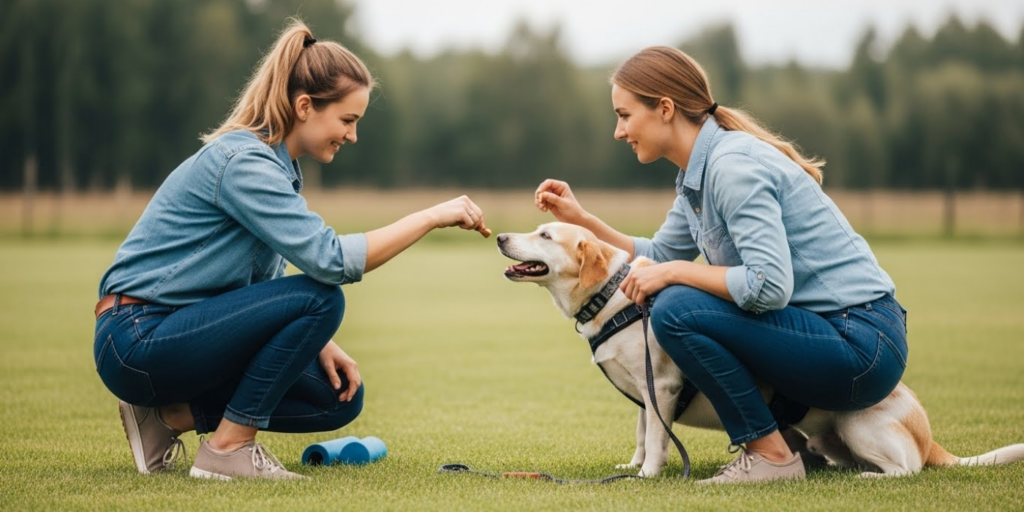
Changing deep-seated behavior takes time—especially if your dog has been practicing it for months or years. Progress isn’t linear. Some days will feel like breakthroughs; others, like setbacks.
Set realistic expectations:
- Mild cases: 4–8 weeks of consistent work.
- Severe reactivity: 3–6 months or more.
- Some dogs may always need management—but can live happily with it.
Track small wins:
- “Today he looked at the mail carrier and stayed quiet for 3 seconds!”
- “She took a treat when the neighbor walked by—without barking!”
Avoid common pitfalls:
- Letting friends “just say hi” to “get her used to people” (this often backfires).
- Skipping management on “bad days.”
- Inconsistency between family members (everyone must use the same cues).
Remember: Your dog isn’t giving you a hard time—they’re having a hard time. Every calm moment is a victory.
Conclusion
Stopping your dog from barking at strangers isn’t about dominance or obedience—it’s about building trust, reducing fear, and teaching new ways to respond to the world. By understanding their emotional trigger, managing their environment, creating positive associations, and offering clear alternatives, you give them the tools to feel safe and succeed.
This journey requires patience, consistency, and compassion—but the reward is priceless: a dog who walks calmly beside you, greets guests politely, and lives with less stress. And that’s a win for both of you.
So start small today. Block that window. Practice “watch me” in your living room. Reward one calm glance at a passerby. These tiny steps lead to big transformation.
What’s your dog’s barking trigger—and what’s one strategy you’ll try this week? Share in the comments! And if this guide gave you hope, pass it along to a fellow dog parent. Because every dog deserves to feel safe—and every owner deserves peace at the door. 🐾

Mary Brown is a devoted pet enthusiast with a lifelong passion for animals of all kinds. From volunteering at local shelters to creating cozy, enriching spaces for her own furry family, she believes that every pet deserves love, comfort, and attentive care. With years of hands-on experience and a heart full of empathy, Mary shares practical tips and heartfelt insights to help fellow pet parents nurture happier, healthier lives for their companions.